| |
|
Ausstellungen
- Projekte (Auswahl)

Voyeurka
- Voyeurin - Voyeuress
Egon Schiele Art Centrum
Ceský Krumlov, 2006
KATALOG
zur Ausstellung bestellen
Preis: € 5,--
(zuzüglich: Verpackung und Versand - Österreich: €
3,30)

Texte
zur Ausstellung:
Hana
Jirmusová
Martin
Hochleitner
Ingeborg
Habereder
Die Ausstellung (Auswahl)

Foto:
Libor Svácek
see you see me
Videoinstallation, 2 Videos
video installation, 2 videos
2006
Foto: Libor Svácek
cybervirgins
3 Leuchtobjekte
3 light objects
60 x 43 x 10 cm
2006

Foto: Libor Svácek
SEX (in progress)
Leuchtobjekt
Light object
17,5 x 8 x 6 cm
2006


Foto:
Libor Svácek
egon´s blue sex box
Videoinstallation
video installation
6 min 21 sec
2006
videostills aus
dem Video
stills from the video
egon´s blue sex box
egon´s
blue sex box
3 Leuchtobjekte
3 light objects
43 x 30,5 x 10 cm
2006
see you see
me

Monika
gesamte Raumaufnahme, Egon Schiele Art Centrum
general view of the exhibition area


Monika
Wäschetonne chrom, Monitor
Laundry basket, chrome, monitor
30 cm x 54 cm
2003


aus dem Video
from the video
Monika II
2 min. 24 sec.
1999 - 2003
Foto:
Libor Svácek
Raumaufnahme Egon Schiele Art Centrum
view of the exhibition area
Foto: Libor Svácek
detail
Tagesbilder I
Kronenzeitung,
Teppichunterlage, Kronenzeitungen, Daily pictures I
Carpet background, Kronenzeitung newspapers
72 x 1050 cm
1995


Herbert
Videoinstallation
LCD Monitor
2 min 2 sec
2005
Foto:
Libor Svácek
Kopulationsautomat
handbetrieben
Copulation machine
hand powered
47 x 25 x 20 cm
1994

Foto:
Libor Svácek
aus der Serie
from the series
Unser Fleisch: Frisch! Aus Österreich
Mischtechnik auf Papier
Our meat: Fresh! From Austria
mixed media on paper
29 x 20 cm
Foto:
Libor Svácek
aus der Serie
from the series
Können Dildos süchtig machen?
Collage und Mischtechnik auf Papier
Can dildos be addictive?
collage and mixed media on paper
ca. 40 x 30 cm
1994

Foto:
Libor Svácek
detail
"Wer gehört werden will, muss zuhören können"
Videoinstallation
"Who wants to be heard, has to be able to listen"
video installation
2003
.........................................................................................................
.........................................................................................................
Kunstverein
Paradigma, Linz
"einfach menschlich"
2005
...eine geringfügige
Veränderung einer Rolle und das ganze System kann blockieren....
u.a. zeigt eine "Männerrunde" (ein vielfältiges
Nebeneinander verschiedenster Männer aus Alltag, Politik, Kultur,
Medien, Sport, Geschichte) in einer raschen Abfolge. Bilder von
Männern aus Medien, Büchern, Zeitungen, Illustrierten
und über Suchmaschinen im Internet gefunden.
Projezierte Textzitate, in Originalschrift Illustrierten entnommen,
in das Medium Dia transferiert, schaffen kontextverschoben eine
neue Bedeutungssituation.
Barbie und Ken
Digitaldruck; matt laminiert
kaschiert auf Aluplatte
110 x 82 cm, 2005
Ankauf Land OÖ, 2005


ega: frauen
im zentrum, Wien
videoinstallation
"projektion"
2003

1
"ich nehme dich"
Videogrossprojektion im Auslagenfenster
2003
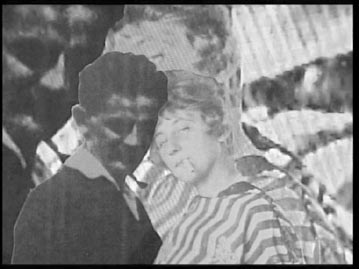
(Hochzeitsfotos
/ Standfotos über Suchmaschinen im Internet gefunden, in Videoformat
übertragen, wechseln im videoloop in einer raschen Abfolge
ab; im Hintergrund ziehen durch die schnelle Bewegung nicht mehr
erkennbare Aufnahmen vorbei; Teile dieser Aufnahmen durchdringen
die Paare und drängen an die Oberfläche)
2
"Ich habe das Paradies gesehen"
Diaprojektion, 2003
Diakarussellprojektor, 81 Dias
"Ich-Zitate", in Originalschrift Illustrierten entnommen,
in das Medium Dia übertragen, werden als Großprojektion
an die seitliche Wand der Projektion "ich nehme dich"
projeziert und schaffen so kontextverschoben eine neue Raum- und
Bedeutungssituation.
frauen-kunst-festival
femme:os, sigharting / oö
"Projektion"
Installation
2002

Die Rolle, das
ist das Funktionieren eines Wesens im Gesellschaftsgefüge,
erscheint oberflächlich nach einfachen Schemen zu erfolgen.
Werden diese aber auch nur geringfügig verändert, kann
das gesamte System blockieren.
Bernadette Hubers ironische Reflexionen über Rollenbilder unterwandern
es subtil, entlarven es als Labyrinth von Projektionen, das über
Geschlechtsdifferenz und Sozialverhalten ins Irrationale mündet.
---
1001 + 1 Nacht
- fragmentierte Erzählstücke
Landesgalerie Oberösterreich am OÖ. Landesmuseum
Linz, 2000
|
 |
1) Video: Monika II; 4 min. 6 sec (videoloop); 2000 |
| 2) Monika: Digitaldruck;
kaschiert auf Aluplatte; 2-teilig; je 150 x 112,5 cm; 2000 |
|
---
Video-Computer-Lichtinstallation
beim Werndldenkmal Steyr (gemeinsam mit Tassilo Blittersdorff)
ein multimediales und interaktives Kunstprojekt im Rahmen der oö.
Landesausstellung 1998
(Mai - November 1998), gefördert im Auftrag des BKA, Dr. Wolfgang
Zinggl
architektonische
und mediale Erweiterung des bestehenden Denkmals von Josef Werndl
(Begründer der Österreichischen Waffenfabrik)
5 Metallboxen, in Steinstruktur bemalt
1 Gewehrattrappe mit Abzugshahn - Vernetzung mit 1 Computer, 1 Computerbildschirm
4 Videomonitore, 4 CDI Player
Scheinwerfer
Foto:
Klaus Fritsch, Wien

Foto:
Klaus Fritsch, Wien

Foto:
Klaus Fritsch, Wien
---
|
Ausstellung
Bernadette Huber
Kulturzentrum bei den Minoriten, Graz
21.10. - 12.10. 1998 |
|
Pressetext
Ausstellung
Bernadette Huber
Kulturzentrum bei den Minoriten, Graz
21.10. - 12.10. 1998
Neben einem Gang
mit Leuchtobjekten (Marienbilder und Alltagszitate) gelangt der
Ausstellungsbesucher in einen abgedunkelten Raum. Eine monotone
Geräuschkulisse erwartet ihn dort, unterbrochen von Gesang
und von Ausschnitten einer Rede eines (wegen einer Frau) in Bedrängnis
geratenen (Macht)mannes (-grundsätzlich ist sie ein guter Mensch
und ich wollte ihr helfen - ich hatte eine unziemliche Beziehung
unterhalten, das war falsch....) Diese (Macht-) spiele kehren sich
im dunklen Raum anscheinend um: die Frau erscheint. Das Wunder von
Lourdes kann jeder für sich erlebbar machen, Erwartungshaltungen
vom Idealbild Frau (Madonna mit Barbiekörper) können erfüllt
werden. Diese Mariendarstellungen-erscheinungen, die interaktiv
(durch Knien auf Gebetspolstern ausgelöst) die weiterlaufende
Audioinstallation "stören", werden in einen neuen
Sinnzusammenhang gebracht. Die Rolle der Frau, der Maria ist vorgegeben:
Sie ist nichts Zufälliges, sie ist ein Konstrukt, in das Männer
ihre Sehnsüchte projeziert haben. Sie ist die Schaffung eines
Frauenbildes nach eigenen Wünschen. Symbolisch wird der Körper
Marias zum Kommunikationssystem. Eine Projektion (bei dieser Ausstellung
im doppelten Sinn) einer Erwartungshaltung nach außen schafft
eine Realität, die es nicht gibt. Eine "öffentliche"
Erscheinung, die nicht nur (armen) Frauen und Kindern erscheint,
sondern über "Abruf" jedem/r verfügbar gemacht
werden kann, erfüllt kollektive Erwartungshaltungen und kollektive
Wahrnehmungsphänomene. Maria liefert das Programm, wie man
sie gerne sehen möchte. Die Programmauswahl ist gering, das
Programm unseren Erwartungshaltungen entsprechend fix vorgegeben.
Im nächsten Raum ladet 1 Spielfeld am Boden des Raumes mit
Kreide aufgezeichnet ein, sich einem Spiel zu nähern, das aus
Kindheitstagen vertraut erscheint. In einem Hüpfspiel (bekannt
als Tempelhüpfen - mit einer virtuellen Einteilung der Realität
in Himmel und Hölle) kann der Besucher seine Geschicklichkeit
in Bewegung - Steuerung sich selbst und dem Galeriepublikum unter
Beweis stellen. Vorgegebene Felder müssen nach einem vorgegebenen
Hüpfschema "richtig bespielt" werden. Eine fernsteuerbare
Madonna auf Rädern wird in immer verschiedene Felder gelenkt,
sie gibt quasi den Weg dieses Hüpfrituals vor, der Spieler
hüpft in dieses Feld, führt die Madonna aus dem Spielfeld
und verläßt dieses dann selber auch wieder. Eine Spielanleitung
auf einem Videobildschirm zeigt das "richtige" Spielverhalten.
Das Spielverhalten des Galeriepublikums wird ständig überwacht
und im Spielraum auf einem Monitor übertragen.
Bernadette Huber, Oktober 1998
|
|

Kulturzentrum
bei den Minoriten, Graz, 1998
"Runter in die Knie und gebetet wie noch nie, ich sagte runter
in die Knie und gebetet wie noch nie.",dann
(vielleicht) interaktive virtuelle Marienerscheinung

Kulturzentrum bei den Minoriten, Graz, 1998Die
Verfügbarkeit der Madonna im persönlichen Weltbild und
Spielverhalten
1 Spielfeld, mit
Kreide aufgezeichnet 1 Madonna auf Rädern, ferngesteuert 2
Monitore, 2 Recorder, 1 Überwachungskamera 5 Spielkarten, 6
Andachtsbildchen
Kulturzentrum
bei den Minoriten, Graz, 1998Die
Verfügbarkeit der Madonna im persönlichen Weltbild und
Spielverhalten
Detailaufnahme: Andachtsbildchen
|
|
---
Galerie im
Traklhaus, Salzburg 1997
|
Erwähnung
Text und Kritik
Peter Assmann: Männerbilder. In: Bernadette Huber, Galerie
im Traklhaus, Salzburg 1997
Männerbilder, das Männliche einer Person, das Männliche
seiner Erscheinung - Schlagworte einer sozialen Geschlechterdiskussion,
die in den letzten Jahren in der Kunst besonders intensiv geführt
wurde. Bernadette Huber schließt in ihren jüngsten Arbeiten
weder an diese Diskussionsstränge an, noch konterkariert sie
diese; mit großer Ironie sucht sie vielmehr den Weg der Annäherung
an dieses Thema. Sie stellt Frische und Originalität anstelle
ausgreifend aufgebauter Kunstkonzepte; sie verbindet vielschichtige
Ironie mit präziser Beiläufigkeit. Obwohl die Ausstellung
in der Galerie im Traklhaus sehr genau durchgeplant ist, vermittelt
die Werkstückreihe der Künstlerin doch vor allem Spontaneität
und große Direktheit im gestalterischen Zugriff. Bernadette
Huber operiert bewußt mit absolut gebräuchlichen Alltagsobjekten,
Alltagsbildern, um diese zum einen durch die Kombination mit einem
anderen Alltagselement - wobei hier etwa auch Textstellen als ein
solches Kompositionselement zu gelten haben - bzw. durch teilweise
minimale Gestaltungsmanipulationen in einen völlig neuen Sinnzusammenhang
zu bringen. Ihre Kompositionen funktionieren auf der Ebene alltäglicher
Wirklichkeit, aus der sie entnommen sind, wie Verkleidungen, wie karnevaleske
Formen, die in ihrem "als ob" um so drastischer die Hohlheit
des jeweils angestrebten Vollbildes aufzeigen: Die große Geste
mutiert zum potemkinschen Dorf; der Anspruch auf dominante Fülle
erweist sich als pure Kosmetik. Es ist allerdings nicht so sehr die
Lust an der Demaskierung - im weitesten Sinn die Lust an einer Dekonstruktion
-, sondern vielmehr die Pointierung auf das Selbstverständliche,
auf das zwar nicht unbedingt für voll genommene, aber doch in
seiner Existenz nicht grundlegend Hinterfragte, auf das die Künstlerin
ihr und des Betrachters Augenmerk legt. Es sind in diesem Sinne "merkwürdige"
Formgestalten, die Bernadette Huber schafft. Eine Welt, in der flache
Schatten versuchen, die gesamte Fülle von Wirklichkeit zu manifestieren.
Dies betrifft im besonderen die Welt der Erotik, deren verschiedentliche
Accessoires eine Art Grundvokabular für die aktuellen Werkkompositionen
der Künstlerin bieten, wobei sie hier sehr genau herausarbeitet,
daß eine spezifische Absurdität nur über die Sichtbarmachung
verschiedener allgemeiner Ebenen des Absurden erfolgen kann. Auch
wenn es gleichsam naheliegend wäre, setzt die Künstlerin
hier kein pauschales Aburteilen oder ausschließliches Den-Finger-in-die-Wunde-Legen.
Sie bemüht sich hier vielmehr, die jeweils verwendeten Accessoires
in ihrem jeweiligen Eigensinn zu erfassen - als seltsam vertraute
Absonderlichkeit, die gesellschaftliche Geschlechtsstereotype gleichsam
rund um sich selbst drehen läßt und die jeweilige Beziehung
zum Betrachter als eine Frage neu formuliert. Diese (durchaus "Gretchen")
Frage richtet sich vor allem an die Identität des einzelnen mit
quasi "gesellschaftlich üblichen" Inhalten, sie stellt
psychische Haltungen vor - durchaus im Hinblick auf deren Korrekturmöglichkeit,
wie (wenig) weitreichend eine solche auch im Einzelfall sein kann.
"Mit anderen Worten: Die Haltung "Von Mann zu Mann"
und "Das verstehst Du nicht, meine Liebe" bedürfen
bei uns keiner besonderen psychischen Disposition des einzelnen. Es
bedarf einer besonderen psychischen Disposition und Erziehung, diese
Haltung nicht zu haben." (Aus: Klaus Theweleit: Männerphantasien,
2. Bd., Frankfurt 1986, S. 385) |
|

Bernadette Huber,
Galerie im Traklhaus, Salzburg, 1997
Ich glaubte, glücklich zu sein
Leuchtpult, Kopien, Folie 16 x 13 x 4 cm, 1997
|
|

Bernadette Huber,
Galerie im Traklhaus, Salzburg, 1997
"Ich bete jeden Tag für mein Glück"
Leuchtpult, Kopien, Folie 16 x 13 x 4 cm, 1997
|
|

Bernadette Huber,
Galerie im Traklhaus, Salzburg, 1997
Er spielte den großen Mann - mit meinem Geld. (Fotoinstallation)
Litho - Giganto, 120 x 200 cm, 1997
|
|

Bernadette Huber,
Galerie im Traklhaus, Salzburg, 1997
Ken und
die Goldbären. (Installation) , 1997
|
| |
|
---
Galeria
QQ, Krakau 1998
|
Lukasz Guzek:
TO PLAY, OR TO BE. Krakow, 1999
tr.Robert Galazka
According to one of the current opinions about artists, they have
a desire to provoke. It is a part of the artist's contemporary mythology,
a legacy of the epoch of modernist avant-garde movements. In fact,
the matter looks altogether different: the artist is provoked by the
surrounding reality and people who create it. Art is born in response
to the world. The controversies appearing in and about art indicate
the points of crisis in the area of culture. Hence, a work of art
is frequently misinterpreted as the source of a problem, which leads
to ignoring its true origins . Nevertheless, art is a good starting-point
for considering the problems of a more general - cultural - nature.
Especially contemporary, post-modern art, which, unlike modernism,
is neither set on merely formal aims nor self- referential; on the
contrary, it looks for content as a guarantor of its place in culture.
Bernadette Huber's installation, The Disposability of the Madonna
in an Individual View of the World and Individual Rules of the Game
(Die Verfügbarkeit der Madonna im persönlichen Weltbild
und Spielverhalten), is a typical example of contemporary art’s searching
for its raison d’etre by placing a work in a cultural area of conflict.
Bernadette Huber’s installation could easily be regarded as a provocation.
Therefore, it makes possible an analysis of the genesis of conflicting
tensions between art and the intellectual clichés that condition the
cultural reception of a work of art. Such a broad outlook enables
the work to become a functional model of contemporary art, which means
that we no longer discuss specific, individual situations, but operate
at the level of general ideas. Let me add here that the model of the
conflict "the artist vs. the world" is falling into disuse
today and the situation is also reflected in Bernadette Huber's installation.
In its basic layer, the model is perfectly binary. The binary structure
may seem too simplified to include all complication and diversity
of man's cultural presence, all the aspects determining that we think
and feel in a certain way and not differently, determining our specific
views. But the basic structure of our thoughts and views is in fact
binary, black and white. Besides, it only seems to us that the views
are ours. They are really cultural clichés, an echo of the patterns
and standards of thought passed on in the process of intracultural
communication. Hence their simplicity: it is a condition necessary
for implanting them in our minds. After all, our view of reality is
black and white, we even "know" well what is black and what
is white, or, to put it differently, what is good and what is evil,
since it is in the sphere of so-called values that the instillation
of the patterns and clichés serves as the basis of general culture's
way of functioning and the forms it assumes. "Colors" result
from the subsequent process of individualization, from life's "processing".
The binary pattern of cultural structure is presented in Bernadette
Huber's installation by means of the quotations excerpted from a prayer
book and the speeches of Pope John Paul II on one hand, and from advertisements
in erotic magazines on the other. In this work, the pattern took on
the form of a field for playing a game of "heaven and hell"
(or "hopscotch"), drawn on the floor of the gallery. The
quotations were placed in the respective parts of the field, marking
out the playing area. In addition to that, a game was being displayed
on the monitor, serving as a sort of instruction and revision of the
rules of the game if somebody had already forgotten his childhood.
The texts represent two realities: the reality of the predominant
religion and the reality of natural human needs, which, according
to the universal cultural pattern, remain in opposition. Both Poland
and Austria are countries where culture is subject to an extremely
strong pressure of the Roman Catholic tradition. Therefore, the religious
aspect in the work executed by the Austrian artist in Poland is not
incidental. Bernadette Huber draws on the algorithmic elements that
influence the general state of the minds. Yet she does not base her
work on abstractions and metaphysical meditations isolated from life,
but stays close to reality. The quotations illustrate the practical
side of religious devotion: the way it is understood and put into
effect in everyday life by individuals and the state officials responsible
for social policy. Eroticism has also been captured in its reality
here: whereas sex described in the magazines is pure fantasy, the
advertisements are placed by real persons informing of their sexual
needs and desires and assuming correctly that there are other people
who feel the same way. The quotations constitute the first, basic
layer of the work, which may be defined as the level of cultural reality.
Its factual content guarantees its credibility, and at the same time
paves the way for the introduction of the third element - the third
layer of the installation. The third layer is the game. It is "superimposed"
on the layer of the quoted texts, situated over it, so to speak; it
is independent, but at the same time transparent. The Madonna - a
self-propelled, remote-controlled figure constructed by the author
for the installation - is the link between the two levels. Moving
the figure along the playing field leads the player through the consecutive
stages of the game, just as in the children's amusement (or in the
instruction on the monitor). On one of the walls of the gallery there
is additionally another Madonna in a small altar with a built-in mechanism
for reproducing sound and voice - in short, a typical example of church-fair
kitsch. It is perfectly complementary to the self-propelled Madonna;
in that context, the latter does not seem a particularly bizarre notion.
At the popular level everything is both possible and "good".
The aesthetics of kitsch is associated with the binary structure of
thinking. The artist emphasizes that meaning of kitsch, making it
the main visual aspect of the work. The level of the game is the level
of art, the sphere in which the artist operates. The model of the
situation presented in the installation is as follows: the dominant
culture and the social practices dependent on it define the playing
area, whereas the artist, thrown into that reality and inevitably
made a part of it, is provoked to join in the game. He cannot escape
reality, but he can enter into a game with its elements. He plays
to save his identity, to be creative, to be himself, to be an artist.
In contemporary art, the artist is no longer a producer of aesthetic
objects and art itself is not fulfilled in a thing called a work of
art, as was the case in modernism according to its major slogan, "art
for art's sake". The artist defines his position in relation to the
world and his environment rather than in reference to art and formal
issues. Although the game is patterned on the children's game that
everybody used to play, it is now intended for adults. By means of
something they have known "forever", the participants are
to make a Freudian journey to the forgotten strata of psyche and bring
to the surface the hidden factors determining the way of thinking
and feeling. It is then that their deep structure and its binary character
become apparent. The involvement of thought in a series of specific,
"everyday" forms usually prevents us from looking so deeply
in, from seeing through to the foundations. And even if such a style
of thinking is not characteristic of a given player, it is now easier
for us to realize its omnipresence around us, in the functional system
of culture. The playing field is a model that presents what is typical
and cultural, and not individual and personal. Each of us has to function
in an abyss that culture opens up between the binary oppositions.
We have to, because a conscious and radical departure from culture,
if at all possible, takes place at the cost of escapism, which may
be literal and involve changing one's residence, e.g. for a monastery
in Rishikesh, but may also take the form of mental illness, or - most
frequently - of anesthetization by unawareness. Living in the global
village has not made any substantial changes in the cultural situation
of a man who has absorbed the cultural model described above since
childhood. Bernadette Huber invites us to play, proposes that the
viewers participate in art, and thus persuades them to adopt the artist's
point of view, to "get into his skin". The game results
in the intermingling of the levels, in the activation of the sphere
between extreme oppositions, which consequently becomes the most important.
Relativism against the absolute - this slogan sums up the basic ideological
premise of Bernadette Huber's work. The overcoming of the binary model
has numerous consequences. Relativism emerges on the surface of culture
as the essence of humanity, as a right of human nature that demands
to be implemented in real life. It is also the most provocative, blasphemous
element in our culture. Postmodernism has been accursed, ridiculed
and vilified for glorifying relativism. At the same time, relativism
is obviously inherent in human nature. The experience of relativism
is the most common. To put it simply, without too much ideologizing
and overinterpretation - it is human. Subject to the domination of
the binary model, our culture refuses to legitimize this experience.
Entering the game between religion and sex, the extreme elements of
our culture, makes us realize that no sphere of human activity can
avoid involvement in such a game. The game is something total - it
is the nature of man, or perhaps of a man of this culture only; it
is also an indication of the present time. Well, the author of these
words comes from this culture too. There is no way of getting out
of one's skin. However, one can always feel more comfortable in it.
|
|

Bernadette
Huber
Galeria QQ, Krakau 1998
Die Verfügbarkeit der Madonna im persönlichen Weltbild
und Spielverhalten
1 Spielfeld, mit Kreide aufgezeichnet, 1 Madonna auf Rädern,
ferngesteuert 2 Monitore, 2 Recorder, 1 Überwachungskamera
1 Hausaltärchen mit Sprechmechanismus, Kopien, Klebefolien
transparent, (polnische Originalzitate / Inserate aus einem Erotik
- Kontaktmagazin und polnisches Zitatmaterial aus katholischen Jahreskalendern
1998)
|
|